
Division of Cancer Cell Regulation
Introduction
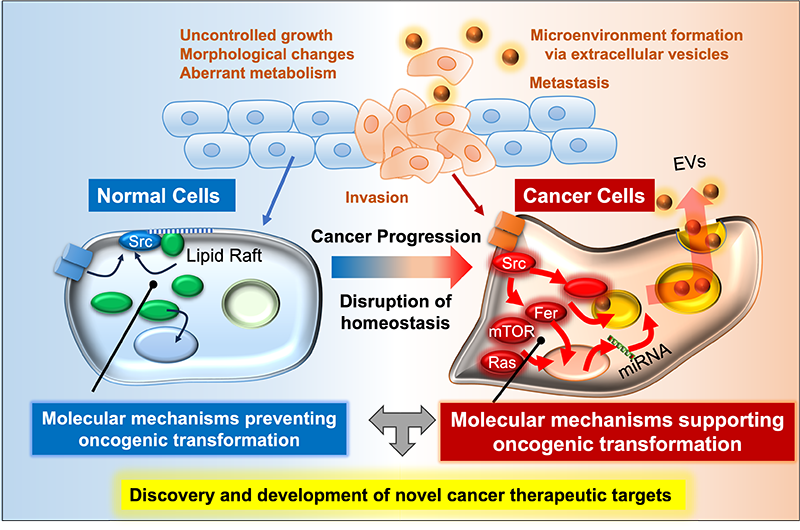
Our laboratory investigates the molecular mechanisms that maintain cellular homeostasis and how their disruption drives cancer development. Normal cells precisely regulate signaling pathways in space, time, and quantity. Genetic and epigenetic alterations, or abnormal extracellular cues, disturb these networks, leading to uncontrolled growth and tumor progression. By dissecting key genes, proteins, and signaling cascades, we aim to uncover how oncogenic phenotypes arise and to identify novel therapeutic targets. Our ultimate goal is to translate these insights into innovative strategies for cancer treatment.
Research topics
We seek to understand the mechanisms maintaining cellular homeostasis and their dysfunction in cancer. Normal cellular homeostasis requires the coordinated regulation of signaling molecules in space, time, and quantity. Accumulation of genetic and epigenetic alterations or oncogenic viral infections disrupts the stringent regulation of signaling networks and leads to cellular transformation and tumor progression. Our studies involve dissecting the genes, proteins, and signaling mechanisms directly responsible for oncogenic phenotypes and identifying novel therapeutic targets. Currently, the goals of our research are to elucidate the molecular mechanisms underlying aberrant activation of Src pathways in a wide variety of human cancer cells.
1) Innovative Imaging and Mechanistic Insights into Exosome Secretion in Cancer
Extracellular vesicles (EVs), including exosomes, are nanoscale particles secreted by cells that mediate intercellular communication. In cancer, EV secretion is markedly increased and contributes to tumor progression by remodeling the microenvironment and establishing pre-metastatic niches.
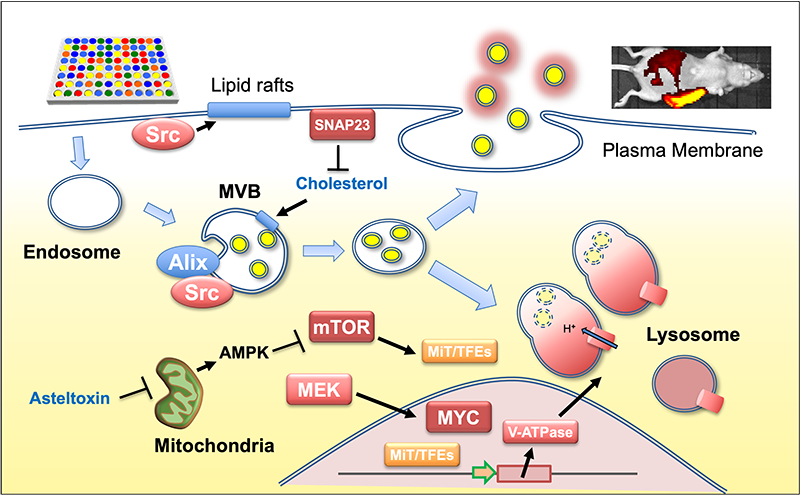
To accelerate research on exosome biogenesis, we developed a quantitative cell system expressing fusion proteins of exosome markers (CD9, CD63, CD81) with the high-intensity luminescent protein NanoLuc. In these cells, luminescence in the culture medium correlates with exosome number, enabling efficient measurement of exosome secretion (Sci Rep, 2018). By transplanting these cells into mice, we established an ex vivo system for long-term tracking of secreted exosomes under physiologically relevant conditions. Furthermore, by incorporating BRET-based red-shifted luminescence, we achieved non-invasive in vivo imaging of exosomes (Sci Rep, 2020; Methods Mol Biol, 2022). Using these systems, we uncovered key mechanisms of exosome secretion. We demonstrated that Src tyrosine kinase, localized on endosomal membranes, interacts specifically with the ESCRT-associated protein Alix, promoting intraluminal vesicle (ILV) formation—the precursor of exosomes. We also identified differences among Src family kinases in their ability to enhance exosome secretion, which correlated with their affinity for lipid rafts (Sci Rep, 2019). Additionally, we found that SNARE proteins, involved in membrane fusion, influence Src localization and exosome release (Biol Pharm Bull, 2022).
Moreover, we found that activation of the MEK/ERK and mTOR pathways is closely linked to enhanced exosome secretion. Activation of these pathways downregulates lysosome-related genes, suppresses endosomal degradation, and consequently promotes exosome release. Inhibition of MEK reverses these effects, restoring endosomal degradation and markedly reducing both exosome secretion and malignant phenotypes. These findings suggest that oncogenic signaling pathways enhance exosome secretion by weakening the endolysosomal degradation machinery, thereby helping cancer cells maintain intracellular homeostasis during tumor progression (Cancer Sci, 2022; Sci Rep, 2022).
More recently, we have focused on how stress conditions within the tumor microenvironment regulate exosome secretion. Tumor cells are constantly exposed to a variety of stresses, including oxidative stress, hypoxia, and nutrient deprivation, yet the impact of these stresses on EV-mediated communication remains poorly understood. Using our imaging and quantitative exosome analysis platforms, we demonstrated that oxidative stress-induced stress granules (SGs) act as negative regulators of exosome secretion. We further showed that the RNA-binding protein G3BP1, a central component of SGs, controls intracellular vesicle trafficking and suppresses exosome release during stress conditions (PNAS, 2026). These findings reveal a previously unrecognized link between the cellular stress response and EV biogenesis, highlighting how tumor cells dynamically modulate intercellular communication in response to environmental challenges. Our results also suggest that stress-dependent regulation may influence not only the quantity of secreted EVs but also the selection of their RNA cargos, providing a new framework for understanding EV-mediated regulation of cancer progression.
Our findings provide powerful tools and insights for studying exosome dynamics in vivo and have uncovered fundamental mechanisms linking oncogenic signaling, cellular stress responses, and EV biogenesis. These advances open new avenues for targeting exosome-mediated communication in cancer therapy and for understanding how tumor cells adapt to the changing microenvironment during cancer progression.
2) Spatial Regulation of Oncogenic Signaling and Development of Cancer Therapies Targeting Multimeric Tyrosine Kinases
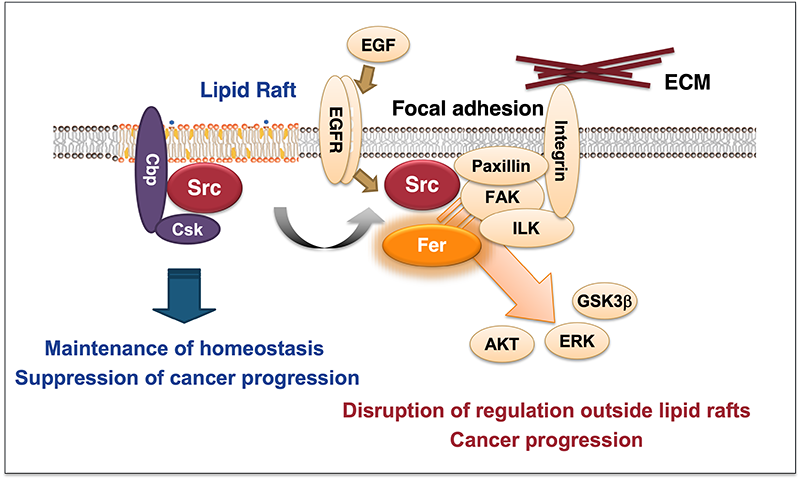
The non-receptor tyrosine kinase c-Src is frequently upregulated in human cancers, driving malignant progression. However, the molecular circuits underlying Src oncogenic signaling remain poorly understood. Our studies revealed that Fer tyrosine kinase acts as a critical mediator and amplifier of Src-induced tumor progression (Oncogene, 2016). We previously demonstrated that fibroblast transformation is promoted by the relocation of c-Src from lipid rafts to non-raft membranes (Mol Cell, 2008; Mol Cell Biol, 2009). Under these conditions, Fer and ezrin were identified as non-raft Src targets. Mechanistically, c-Src initiates Fer autophosphorylation, which is further amplified through Fer oligomerization. Fer interacts with active Src at focal adhesions and phosphorylates ezrin, promoting cytoskeletal remodeling and cell transformation. Importantly, Fer activation is essential for tumorigenesis and invasiveness in cancers with elevated Src activity, including those driven by v-Src or EGFR signaling. Fer expression is upregulated in multiple cancers (colon, lung, pancreas, breast, kidney), yet its knockdown has minimal impact on normal cell growth, highlighting its potential as a selective therapeutic target.
To translate these findings, we screened small molecules targeting Fer and identified lead compounds that strongly inhibit cancer cell proliferation while exhibiting low toxicity toward normal cells. These candidates represent a new class of selective kinase inhibitors, distinct from conventional TKIs, and may offer highly specific cancer therapies.
Our work uncovers the Src–Fer axis as a novel oncogenic signaling pathway and provides a foundation for developing precision therapies targeting multimeric tyrosine kinases.
3) MicroRNA-Mediated Regulation of Oncogenic Signaling: Uncovering the Hidden Layers of Cancer Progression
The non-receptor tyrosine kinase c-Src is frequently overexpressed and activated in many human cancers, yet the molecular mechanisms driving its oncogenic effects remain unclear.
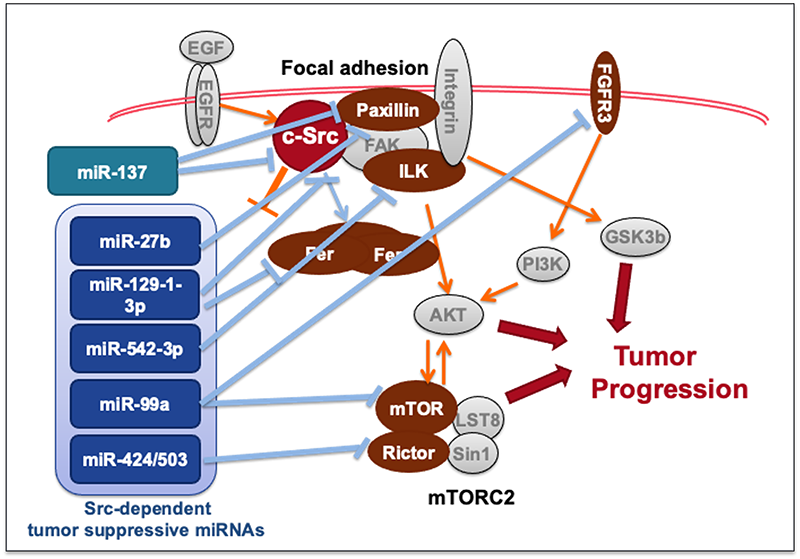
To investigate this, we developed an experimental system using Csk-deficient mouse embryonic fibroblasts, where c-Src activation induces cellular transformation. Using this model, we compared microRNA (miRNA) expression profiles between non-transformed and c-Src-transformed cells. Microarray analysis revealed that c-Src activation alters a limited set of miRNAs: seven downregulated and six upregulated (>2-fold). Functional studies demonstrated that these miRNAs mediate c-Src-driven oncogenic signaling and create crosstalk with other pathways, including mTOR and focal adhesion signaling. Importantly, signaling molecules such as Src and mTOR are interconnected not only through phosphorylation and protein-protein interactions but also via translational regulation by miRNAs (Oncogene, 2011; Oncogene 2012, Cancer Sci, 2016, Cancer Sci, 2020).
This interplay between kinases and miRNAs provides new insights into cancer progression, invasiveness, and drug resistance. Understanding miRNA-mediated regulation of Src signaling may lead to novel therapeutic strategies targeting these non-coding RNAs.
Our findings highlight miRNAs as critical regulators of oncogenic signaling networks and potential targets for precision cancer therapy.
Members
1995 M.S., Graduate School of Science, Osaka University
1995-2003 Research associate, Tokyo Research Laboratories, Kyowa Hakko Kogyo Co., Ltd.
2003 PhD., Graduate School of Medicine, Osaka University
2003-2005 Postdoctoral Fellow, Osaka Bioscience Institute
2005-2007 Postdoctoral Fellow, Research Institute for Microbial Diseases, Osaka University
2007-2011 Assistant Professor, Research Institute for Microbial Diseases, Osaka University
2011-2015 Associate Professor, Research Institute for Microbial Diseases, Osaka University
2015-present Chief, Aichi Cancer Center Research Institute
2016-present Visiting Professor, Graduate School of Pharmaceutical Sciences, Nagoya City University
2017-2021 Researcher, JST PRESTO “Fine Particles”
2018-present Visiting Professor, Graduate School of Medicine, Nagoya University
2020-present Visiting Professor, Institute of Nano-Life-Systems, Nagoya University
Analysis of stress responses and secretion inhibition signaling using extracellular vesicles as markers
mechanisms of risk factors, expanding the possibilities for new molecular targets and drug selection.
2009 M.S. Graduate School of Pharmaceutical Sciences, Osaka University
2012 PhD., Graduate School of Pharmaceutical Sciences, Osaka University
2012-2015 Specially Appointed Postdoctoral Fellow, WPI Immunology Frontier Research Center (IFReC), Osaka University
2015-2016 Specially Appointed Postdoctoral Fellow, Graduate School of Medical Sciences, Kanazawa University
2016-2018 Specially Appointed Assistant Professor, Graduate School of Medical Sciences, Kanazawa University
2018-2024 Specially Appointed Assistant Professor, WPI Nano Life Science Institute (NanoLSI), Kanazawa University
2021-2024 Specially Appointed Assistant Professor, WISE Program for Nano-Precision Medicine, Science, and Technology, Kanazawa University
2024-2025 Team Leader, Chemical Manufacturer
Through research that builds a bridge from the movements of tiny molecules to life-saving medical care, I want to contribute to society.
Publications
Original article
- Dong Y, Yoshida T, Maeda M, Adachi H, Eguchi A, Mishiro-Sato E, Okuzaki D, Kataoka Y, Yoshida T, *Oneyama C. Stress granules as RNA triage hubs suppress extracellular vesicle secretion under oxidative stress in cancer. Proc Natl Acad Sci USA, 2026;123:e25339901
- Adachi H, Yoshida T, Itoh R, *Oneyama C. Ouabain suppresses CD63 loading into extracellular vesicles via Na⁺/K⁺-ATPase-dependent localization to autophagosomes. Biol Pharm Bull, 2025;49:291-300
- Kunitake K, Mizuno T, Hattori K, Oneyama C, Kamiya M, Ota S, Urano Y, Kojima R. Barcoding of small extracellular vesicles with CRISPR-gRNA enables comprehensive, subpopulation-specific analysis of their biogenesis/release regulators. Nat Commun. 15(1), 9777 (2024)
- Hayasaka R, Tabata S, Hasebe M, Ikeda S, Hikita T, Oneyama C, Yoshitake J, Onoshima D, Takahashi K, Shibata T, Uchida K, Baba Y, Soga T, Tomita M, Hirayama A, Metabolomics of small extracellular vesicles derived from isocitrate dehydrogenase 1-mutant HCT116 cells collected by semi-automated size exclusion chromatography. Front Mol Biosci., 9, 1049402 (2023)
- Mitani F, Hayasaka R, Hirayama A, *Oneyama C. SNAP23-Mediated Perturbation of Cholesterol-Enriched Membrane Microdomain Promotes Extracellular Vesicle Production in Src-Activated Cancer Cells. Biol Pharm Bull. 45(10):1572-1580, 2022. (PMID: 36184518)
- Hikita T, *Oneyama C. Quantification and Imaging of Exosomes via Luciferase-Fused Exosome Marker Proteins: ExoLuc System. Methods Mol Biol. 2524:281-290, 2022. (PMID: 35821479)
- Mitani F, Lin J, Sakamoto T, Uehara R, Hikita T, Yoshida T, Setiawan A, Arai M, *Oneyama C. Asteltoxin inhibits extracellular vesicle production through AMPK/mTOR-mediated activation of lysosome function. Sci Rep. 12(1):6674, 2022. (PMID: 35461323)
- Hikita T, Uehara R, Itoh RE, Mitani F, Miyata M, Yoshida T, Yamaguchi R, *Oneyama C. MEK/ERK-mediated oncogenic signals promote secretion of extracellular vesicles by controlling lysosome function. Cancer Sci. 113(4):1264-1276, 2022. (PMID: 35108425)
- Morioka S, Nakanishi H, Yamamoto T, Hasegawa J, Tokuda E, Hikita T, Sakihara T, Kugii Y, Oneyama C, Yamazaki M, Suzuki A, Sasaki J, Sasaki T. A mass spectrometric method for in-depth profiling of phosphoinositide regioisomers and their disease-associated regulation. Nat Commun. 13(1):83, 2022. (PMID: 35013169)
- Kunou S, Shimada K, Takai M, Sakamoto A, Aoki T, Hikita T, Kagaya Y, Iwamoto E, Sanada M, Shimada S, Hayakawa F, Oneyama C, Kiyoi H. Exosomes secreted from cancer-associated fibroblasts elicit anti-pyrimidine drug resistance through modulation of its transporter in malignant lymphoma. Oncogene, 40(23):3989-4003, 2021. (PMID: 33994542)
- Ito RE, Oneyama C, Aoki K. Oncogenic mutation or overexpression of oncogenic KRAS or BRAF is not sufficient to confer oncogene addiction. PLoS One, 16(4): e0249388, 2021. (PMID: 33793658)
- Nishimura T, Oyama T, Hu HT, Fujioka T, Hanawa-Suetsugu K, Ikeda K, Yamada S, Kawana H, Saigusa D, Ikeda H, Kurata R, Oono-Yakura K, Kitamata M, Kida K, Hikita T, Mizutani K, Yasuhara K, Mimori-Kiyosue Y, Oneyama C, Kurimoto K, Hosokawa Y, Aoki J, Takai Y, Arita M, Suetsugu S. Filopodium-derived vesicles produced by MIM enhance the migration of recipient cells. Dev Cell, 56(6): 842-859.e8, 2021. (PMID: 33756122)
- Hikita T, Miyata M, Watanabe R, *Oneyama C. In vivo imaging of long-term accumulation of cancer-derived exosomes using a BRET-based reporter. Sci Rep, 10(1): 16616, 2020. (PMID: 33024173)
- Watanabe R, Miyata M, *Oneyama C. Rictor promotes tumor progression of rapamycin-insensitive triple-negative breast cancer cells. Biochem Biophys Res Commun, 531(4):636-642, 2020. (PMID: 32819718)
- Okuzaki D, Yamauchi T, Mitani F, Miyata M, Ninomiya Y, Akamatsu H, *Oneyama C. c-Src promotes tumor progression via downregulation of miR-129-1-3p. Cancer Science, 111(2): 418-428, 2020 (PMID: 31799727)
- Hikita T, Kuwahara A, Watanabe R, Miyata M, *Oneyama C.: Src in endosomal membranes promotes exosome secretion and tumor progression. Sci Rep, 9(1): 3265, 2019. (PMID: 30824759)
- Hikita T, Miyata M, Watanabe R, *Oneyama C.: Sensitive and rapid quantification of exosomes by fusing luciferase to exosome marker proteins. Sci Rep, 8(1): 14035, 2018. (PMID: 30232365)
- Kokuda R, Watanabe R, Okuzaki D, Akamatsu H, *Oneyama C.: MicroRNA-137-mediated Src oncogenic signaling promotes cancer progression. Genes Cells, 23(8): 688-701, 2018. (PMID: 29962093)
- *Oneyama C, Yoshikawa Y, Ninomiya Y, Iino T, Tsukita S, Okada M.: Fer tyrosine kinase oligomer mediates and amplifies Src-induced tumor progression. Oncogene, 35(4): 501-512, 2016. (PMID: 25867068)
- Matsuyama R, Okuzaki D, Okada M, *Oneyama C.: miR-27b suppresses tumor progression by regulating ARFGEF1 and the focal adhesion signaling. Cancer Science, 107(1): 28-35, 2016. (PMID: 26473412)
- Kakumoto K, Ikeda J, Okada M, Morii E, *Oneyama C.: mLST8 promotes mTOR-mediated tumor progression. PLoS One, 10(4): e0119015, 2015. (PMID: 25906254)
- Kajiwara K, Yamada T, Bamba T, Fukusaki E, Imamoto F, Okada M, *Oneyama C.: c-Src-induced activation of ceramide metabolism impairs membrane microdomains and promotes malignant progression by facilitating the translocation of c-Src to focal adhesions. Biochem J, 458(1): 81-93, 2014. (PMID: 24266736)
- *Oneyama C, Kito Y, Asai R, Ikeda J, Yoshida T, Okuzaki D, Kokuda R, Kakumoto K, Takayama K, Inoue S, Morii E, Okada M.: MiR-424/503-mediated Rictor upregulation promotes tumor progression. PLoS One, 8(11): e80300, 2013. (PMID: 24244675)
- *Oneyama C, Morii E, Okuzaki D, Takahashi Y, Ikeda J, Wakabayashi N, Akamatsu H, Tsujimoto M, Nishida T, Aozasa K, Okada M.: MicroRNA-mediated upregulation of integrin-linked kinase is crucial for Src-induced tumor progression. Oncogene, 31(13), 1623-1635, 2012. (PMID: 21860426)
- *Oneyama C, Ikeda J, Okuzaki D, Suzuki K, Kanou T, Shintani Y, Morii E, Okumura M, Aozasa K, Okada M.: MicroRNA-mediated downregulation of mTOR/FGFR3 controls tumor growth induced by Src-related oncogenic pathways. Oncogene, 30(32): 3489-3501, 2011. (PMID: 21383697)
- Kuroiwa M, Oneyama C, Nada S, Okada M.: The guanine nucleotide exchange factor Arhgef5 plays crucial roles in c-Src-induced podosome formation. J Cell Sci, 124: 1726-1738, 2011. (PMID: 21525037)
- Suzuki K, Oneyama C, Kimura H, Tajima S, Okada M.: Downregulation of the tumor suppressor Cbp/PAG1 is mediated by epigenetic histone modifications via the MAPK/PI3K pathway. J Biol Chem, 286(18): 15698-15706, 2011. (PMID: 21388951)
- Kanou T, Oneyama C, Kawahara K, Okimura A, Ohta M, Ikeda N, Shintani Y, Okumura M, Okada M.: The transmembrane adaptor Cbp/PAG1 controls the malignant potential of human non-small cell lung cancers that have c-src upregulation. Mol Cancer Res, 9(1): 103-114, 2011. (PMID: 21156787)
- Hikita T, Oneyama C, Okada M.: Purvalanol A, a CDK inhibitor, effectively suppresses Src-mediated transformation by inhibiting both CDKs and c-Src. Genes Cells, 15(10): 1051-1062, 2010. (PMID: 20825494)
- Oneyama C, Iino T, Saito K, Suzuki K, Ogawa A, Okada M.: Transforming potential of Src family kinases is limited by the cholesterol-enriched membrane microdomain. Mol Cell Biol, 29(24): 6462-6472, 2009. (PMID: 19822664)
- Inoue K, Sone T, Oneyama C, Nishiumi F, Kishine H, Sasaki Y, Andoh T, Okada M, Chesnut JD, Imamoto F.: A versatile nonviral vector system for tetracycline-dependent one-step conditional induction of transgene expression. Gene Therapy, 16(12): 1383-1394, 2009. (PMID: 19759563)
- Oneyama C, Hikita T, Enya K, Dobenecker MW, Saito K, Nada S, Tarakhovsky A, Okada M. : The lipid raft-anchored adaptor protein Cbp controls the oncogenic potential of c-Src. Mol Cell, 30(4): 426-436, 2008. (PMID: 18498747)
- Saito K, Enya K, Oneyama C, Hikita T, Okada M.: Proteomic identification of ZO-1/2 as a novel scaffold for Src/Csk regulatory circuit. Biochem Biophys Res Commun, 366(4): 969-975, 2008. (PMID: 18086565)
- Oneyama C, Hikita T, Nada S, Okada M.: Functional dissection of transformation by c-Src and v-Src. Genes Cells, 13(1): 1-12, 2008. (PMID: 18173743)
- Yagi R, Waguri S, Sumikawa Y, Nada S, Oneyama C, Itami S, Schmedt C, Uchiyama Y, Okada M.: C-terminal Src kinase controls development and maintenance of mouse squamous epithelia. EMBO J, 26(5): 1234-1244, 2007. (PMID: 17304209)
- Sukezane T, Oneyama C, Kakumoto K, Shibutani K, Hanafusa H and Akagi T.: Human diploid fibroblasts are resistant to MEK/ERK-mediated disruption of the actin cytoskeleton and invasiveness stimulated by Ras. Oncogene, 24: 5648-5655, 2005. (PMID: 16007212)
- Oneyama C, Agatsuma T, Kanda Y, Nakano H, Sharma SV, Nakano H, Narazaki F and Tatsuta K.: Synthetic Inhibitors of Proline-Rich Ligand-Mediated Protein-Protein Interaction: Potent Analogs of UCS15A. Chemistry & Biology, 10: 443-451, 2003. (PMID: 12770826)
- Oneyama C, Nakano H and Sharma SV.: UCS15A, a novel small molecule, SH3 domain-mediated protein-protein interaction blocking drug. Oncogene, 21: 2037-2050, 2002. (PMID: 11960376)
- Sharma SV, Oneyama C, Yamashita Y, Nakano H, Sugawara K, Hamada M, Kosaka N and Tamaoki T.: UCS15A, a non-kinase inhibitor of Src signal transduction. Oncogene, 20: 2068-2079, 2001. (PMID: 11360191)
Education & Training
Our laboratory is a part of the Nagoya University Graduate School of Medicine and Nagoya City University Graduate School of Pharmaceutical Sciences. Foreign graduate students are welcome to study in our programs, including those who are supported by the Japanese Government Monbusho (MEXT) scholarship. For details regarding entrance examinations and scholarships, please follow this link.
